Digital Brain Project
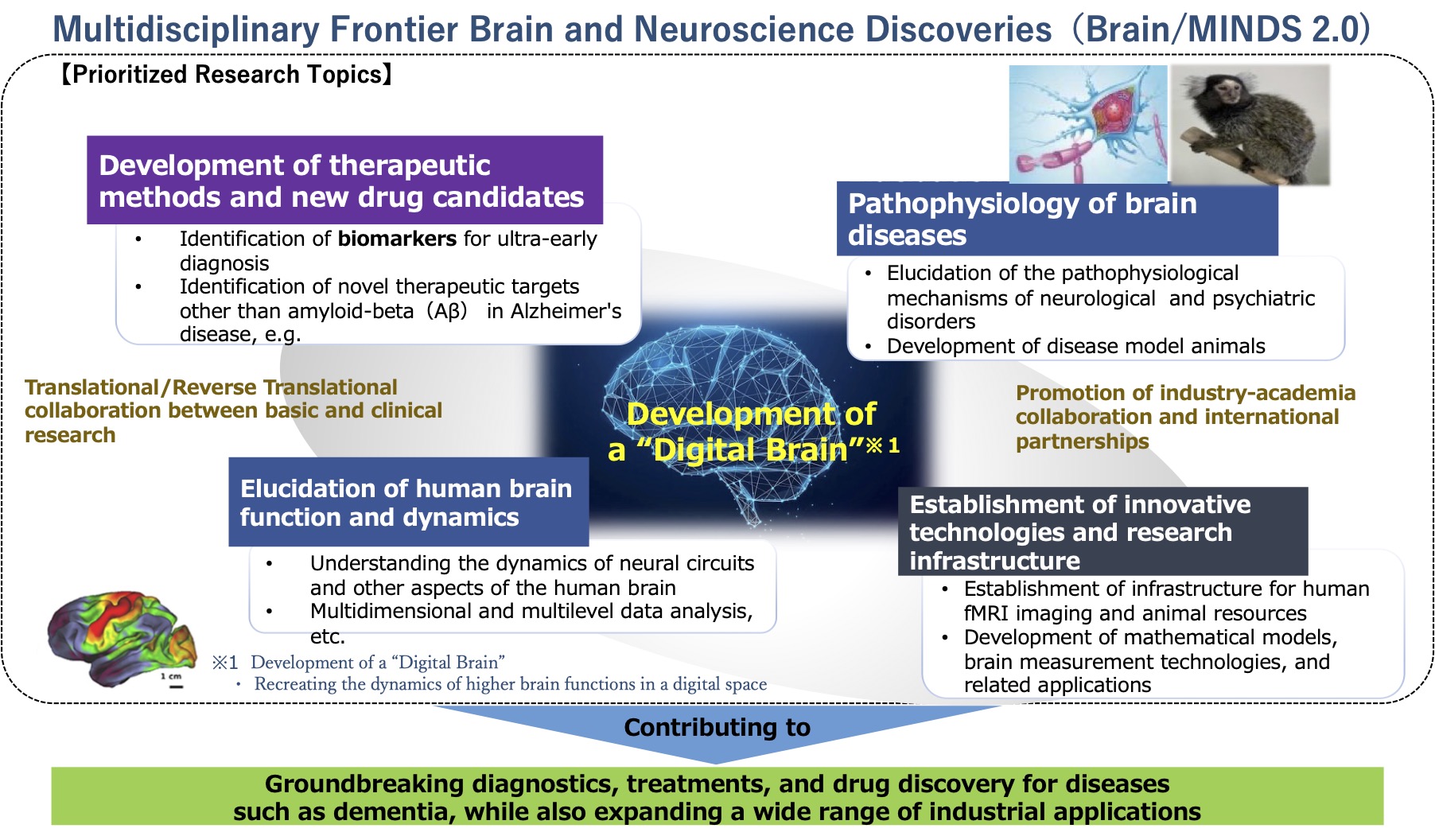
Following the conclusion of the Brain/MINDS project (2014-2024), a new six-year program Multidisciplinary Frontier Brain and Neuroscience Discoveries (Brain/MINDS 2.0) has started.
A remarkable feature of this program is that the Digital Brain plays a central role in integrating structural and dynamic brain data from multiple species for understanding brain functions and tackling neuropsychiatric disorders.
Software
We are developing Neuro-Workflow, an AI-assisted GUI tool for neural data analysis, model building, simulation, visualization, and optimization.
We also developed OptiNiSt for calcium imaging data analysis pipelines.
Forthcoming Events
-
To facilitate discussions about how to build and to utilize digital brains, we organize Digital Brain Seminars.
Most of the talks are available on the YouTube channel. -
We are planning the 3rd Digital Brain Workshop on October 10-12, 2026 at Juntendo University Urayasu Hinode Campus.
Previous Events
-
February 4-5, 2026: EBRAINS Workshop at ATR.
-
October 17-19, 2025: The 2nd Digital Brain Workshop in collaboration with Institute of Mathematics for Industry, Kyoshu University
-
July 24 and 25, 2025: Three Symposia on the Digital Brain during the Japan Neuroscience Society meeting in Toki Messe, Niigata.
-
July 23, 2025: Satellite Symposium: Connecting Digital Brains Across the World for the Japan Neuroscience Society meeting in Toki Messe, Niigata.
-
September 19-21, 2024: The 1st Digital Brain Workshop in collaboration with Institute of Mathematics for Industry, Kyoshu University
Organization
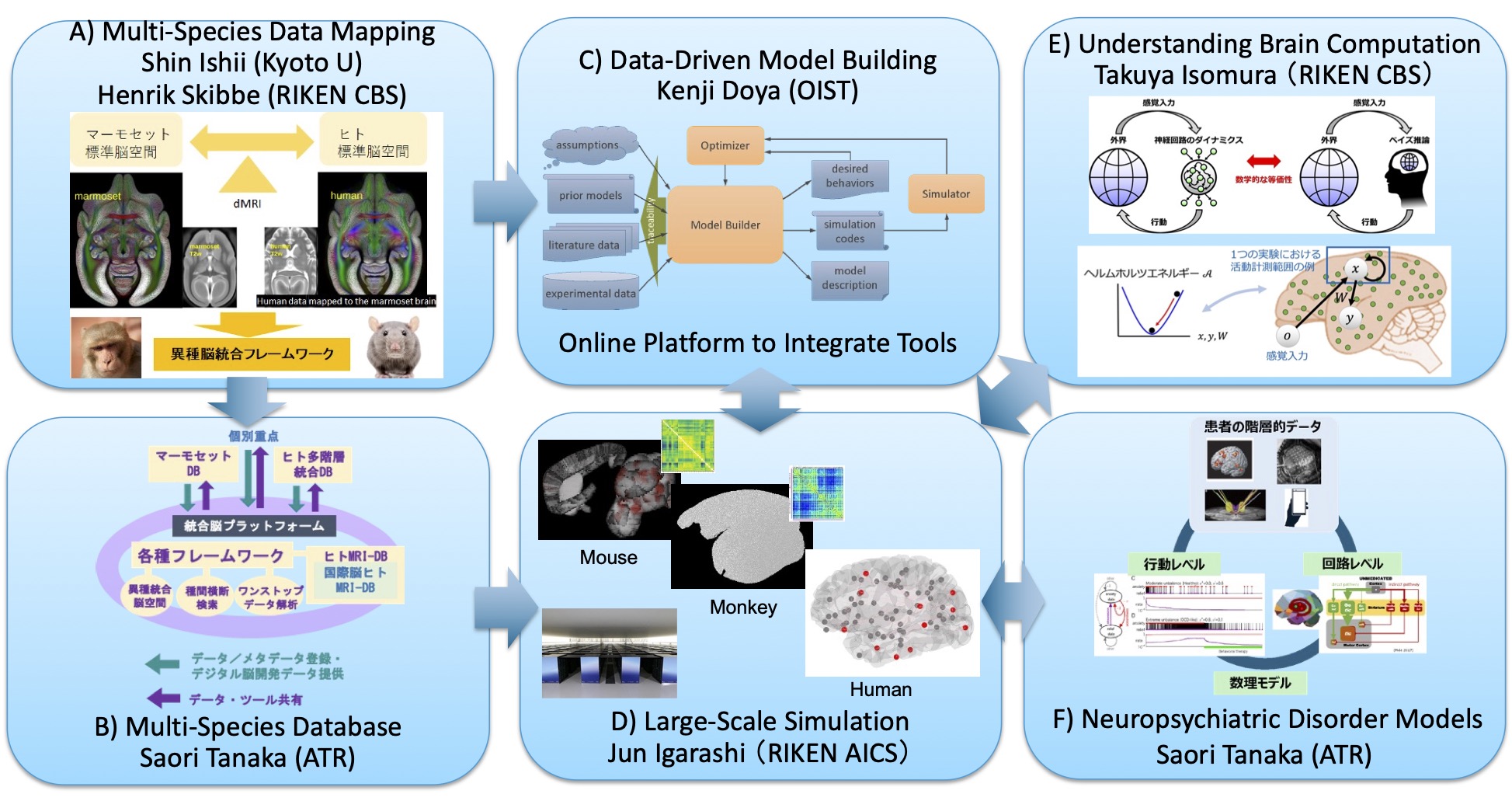
Group 4 of the Brain/MINDS 2.0 Core Organization is in charge of Digital Brain Development with the following PIs.
- Shin Ishii, Kyoto University
- Henrik Skibbe, RIKEN CBS
- Saori Tanaka, ATR
- Kenji Doya, OIST (group head)
- Jun Igarashi, RIKEN AICS
- Takuya Isomura, RIKEN CBS (group subhead)
Additionally, 22 PIs were selected for the priority research on Digital Brain Development.
From 2024
- Yuji Ikegaya, University of Tokyo: External digitization of brain information
- Keiichi Kitajo, National Institute of Natural Sciences: Data assimilation for neurodevelopmental disorders
- Yasuharu Koike, Institute of Science Tokyo: Motion and sensation in VR environments
- Ken Nakae, National Institute of Natural Sciences: Digital twin of common marmoset
- Riichiro Hira, Institute of Science Tokyo: Large-scale compuational neuroscience by LLM
- Tadashi Yamazaki, U Electro-Communications: Scaling microcircuits across species and resolutions
- Yuichi Yamashita, National Center of Neurology and Psychiatry: Mesoscopic digital brain for mental disorders
- Takuto Okuno, Tokyo Metropolitan University: Virtual neuromodulaton and treatment
- Yukiyasu Kamitani, Kyoto University: Neural code conversion between indviduals and species
- Carlos Enrique Gutierrez, OIST: BrainScaler for multi-scale brain modeling
- Zhe Sun, Juntendo University: Brain simulatoin and deep learning by high-dimensional neural data
- Tomohiko Takei, Tamagawa University:ANN modeling of movement disorders
- Mari Tada, Niigata University: Digital atlas of human brain gene expression
- Hiromichi Tsukada, Chubu University: Data-driven whole brain model for etiology
- Akihiro Funamizu, University of Tokyo: Hierarchical cyber brain with genes, circuit and behavior
- Yuichiro Yada, Nagoya University: Abnormal protein accumulation and glia cell network
From 2025
- Hidehiko Takahashi, Institute of Science Tokyo: Internet addiction and ADHD
- Taira Kobayashi, Yamaguchi University: Human brain-body simulation
- Yuta Takahashi, National Center of Neurology and Psychiatry: Micro-macro digital twin brain
- Yusuke Takeda, ATR: Hallucination and delusion in connectome dynamics models
- Kosuka Hamaguchi, Kahoshima University: Transitions of decision making circuites
- Teppei Matsui, Doshisha University: Cross-species brain image translation